About Me

My photo
Documenting a period in my development that could become pivotal
Showing posts with label symbolism. Show all posts

Wednesday, January 13, 2010

Memory from Woodsman Restaurant, Philomath, Oregon


When a painter friend and another friend, a weaver, and I entered the Woodsman Restaurant it was a very gray dreary day. We had a hot exotic Thai food lunch. We talked about the meanings of words like conceptual art, abstract art, objective art, non-objective art and gesture. The language about art is ambiguous. Gestural art could mean the human gestures of the subject or gesture could mean the movements of the artist leaving a mark where a gesture was made. Concepts could be the idea of a physical body and a realistic depiction. Or conceptual could be a meaning we put forth that doesn't have a physical shape. It was also clear that these words mean different things to different people.

This talk did not give me much food for furthering a group exhibit. Then when we were getting up to leave the sun started to light up the room and I saw a couple eating by the window and all the steam rising. I just loved the image and drew it from memory.

I could not detect much interest in arranging a group show around the theme of what is most precious and around expressing what is precious in ceramic material or woven fibers. The story hour for preschoolers was not well attended. I did receive a suggestion from a boy. He said books were the most awesome thing ever. And then he wanted to stay longer and draw a picture of his other idea an apple. These are very physical but the idea of being nurtured in both is intriguing.

Posted by Picasa

Monday, June 15, 2009

Highlights of the Dialog on Peace Making Art.

The reason I compare pottery wheel cultures with ones that did not have a wheel is to show that cultures with the similar techonology have symbols in common. With common symbols from our past, we can artfully communicate bridges to trust. My comaparison does not show that hand made art is inferior to art made with invented tools.
To see some examples of pots made without a wheel click on this link. http://images.encarta.msn.com/xrefmedia/sharemed/targets/images/pho/000a4/000a4fbe.jpg


The dialog on the subject of American Indian ceramics warents a more in depth explanation than I was giving in comments. Below I have tried first to pick out important parts of the dialog on a previous post. Then I will go into my extended explanation.

"Peace making art"

Darlene said...
What a fascinating post on the history of ceramics. I really enjoyed it and compliment you on the exhaustive research on the subject.
2:02 PM
Parapluie said...
Thanks Darlene, I have picked up on these ideas over many years and I keep thinking of their meaning by writing and painting making connections.Recently I have watched the Questar Mystic Lands DVD series. It was interesting to contrast the ancient mariners of Persia with an advanced culture that did not develop a potters wheel.The Anasazi mysteriously disappeared 700 years ago in the four corners of the United States. The Anasazi made lop sided ceramics that look like they were made on the dry ground without even a turnette. Yet they were always seeking a spiritual center according to Pueblo myth. They built a spiritual space with temporary dwellings in a canyon. It had seven roads leading to it like the spokes of a wheel. All appeared to be lead back to settlements except one that lead to a dead end with unusual rocks. All along the road were shards of broken pottery. The Pueblo people believe the ceramics were offerings to the gods. The Anasazi broke them because they feared someone would come and steal them if they were whole. I speculate that the rounded boulders in the canyon at the end of the road symbolized life and trust in the other world from which they appeared to come like themselves. The eroded pedestal was the hopelessness of this world. They did not have a feeling for their pottery was a vessel like themselves filled with life's waters. They could not have felt the feeling of clay centered on the wheel and the water in the clay along with the centrifugal force giving the potter the feeling that the pot is alive.

Then "Rain", who has studied the Native American History of the Four Corners found my premise unsupportable from her own experience owning replicas of their ceramics. She believes a wheel is not needed to make uniformly round pots. Rounded uniform pots can be made from coils or slabs. Rain contends furthermore that water cannot be kept in ceramic vessels burned at low temperatures in open pits because the low fire ceramic is too porous.

To make a uniformly round pot from coils the clay is rolled between the hands making the clay particles line up around and around themselves in tight formation. The coils configured of organized particles resist being pushed together. The wrapped coils forming a vessel must be either glued together with slip or pinched together leaving weak and strong unevenness at its basic structure. The appearance can be evened out by beating the exterior with a flat potters rib while pressing from the inside of the vessel outward with the other hand. All the while one is beating on the clay either the vessel must be moved evenly like on a tournette or the potter has to move around. When the potter moves around lopsidedness occurs which is then distorted even more during the firing.

Building uniform rounded pots from slabs has a number of physical problems. First, when the flat surface is pushed out for the belly of the pot, the slab becomes thinner. When the slab is necked in for the top of container the slab becomes pinched together in folds and much thicker. A rounded slab construction may have all the clay particles in alignment but because the clay wall is so thin at the belly and thick at the neck it may not even make it through the firing. And the pots that hold together through the firing may not contain water well.

In contrast with hand building, wheel "thrown" pots have the help of an extra hand - centrifugal force pushing up and outward. The potter keeps the clay particles centered while a uniformly thick wall is thrown up by the force.

I do not have an expertise for a comparison of the quality of clays of the Colorado River and Four Corner Area to the clays of the Tigris, Euphrates, Nile, and Yellow River. The inland clay of the Four Corners may have been so poor for holding together that even with a tournette or potters wheel the clay could not have stored water.

As for clay slab construction: Hand building is not without the technology of the wheel. The outer edge of a hand rolled slab is thinner than the center. So if a pot is fashioned from a rolled slab the foot would become the center of the vessel and the thinner outer edge would have to be the necked in to a smaller top.

There are other ways to make uniform slabs without the wheel. A slab can be formed by throwing the clay on a flat surface repeatedly. This works with clay of good elasticity but if the clays of the Four Corners were poor quality the clay would have just crumbled apart. They may have been limited to coil or small pinch pots.

Still another way to make slabs is to cut a rounded ball of clay with a long cutting edge like twine or strong hide strips.They probably did not have wire. Cutting a ball of clay would make a slab with less organized particles than the rolled ones. The air bubbles could cause the pot to break during firing.

The drawings were done about 30 years ago. They show the physical dynamics of the hand building technique as being awkward for making uniformly rounded vessels.

Saturday, June 13, 2009

Can a vase save the world?

In our present day world a vase alone cannot magically save us from nuclear extinction. In prehistoric times clay vessels did save lives. A rounded clay vessel was technology which was so miraculous that it could be seen as magic. Dust mixed with water and shaped into a pot could be transformed by fire into a hardened vessel that holds water vital to life. Rounded clay vessels were associated with the continuation of life because they were round and full like a healthy pregnant woman.

In a previous post to this blog I outlined briefly the history of the use of clay vessels as a symbol that changed the way we treated one another. Other art forms like books, carpets, and paintings have symbolic histories as well that have brought about changes in social interactions between differing and competitive peoples. I do agree about their vital rolls in our history. The vase I purpose has some unique symbolism that might be useful as a tool to educate the giver being The United States at the same time as giving the receiver a sense of equality and shared responsibility.

Antonia Acock’s Red Cedar porcelain vase could have a particular relevance to our relationship to third world countries who we see as nuclear threats. Her vase was painted to commemorate the thirty acres of red cedar forest clear cut on the Oregon coastal range during the Bush administration trying to keep the economy going at all costs to our resources sustaining life when we were waging war against a supposed nuclear threat of Iraq. Acock wanted to commemorate the little contested loss of a treasure valued by her Native American ancestors. She knows it is important to paint on archival porcelain that will outlast fiber and even hot fires.

The symbolism in the Red Cedar vase could encompass more than her sensitive use of the materials. New symbolism could be added to all the other points in history where societies became more civil such as replacing human and animal sacrifices with pottery vessels. New symbolism could be added to bring about equality of rich and poor like when pots were first used in death rituals. Other grand purposes could be added to women’s rights like when vases instead of trading wives was a ritual of observing equality between nations.

The shape of porcelain vases like the Red Cedar vase symbolizes life universally understood. To me the vase also symbolizes our shame and fear. The vase reminds me of the ceramic shell of the Atomic bombs unnecessarily dropped on innocent civilians in Japan after what could have been the end of the war. The vase’s shape is our humiliating past and symbolizes our fear that other nations will be equally irresponsible. Our arrogance that we can police the world in preventing nuclear energy’s misuse is not sustainable. We will not have red cedar forests anymore to sustain us.

On the positive side of giving a vase of Red Cedars as a gift to begin real talks with competitive nations is that we can say we all have failings and we can start to work together as equals.

Saturday, April 05, 2008

Pebble from Cebolia Camp

"Primal Pebble"
I picked up a cool pebble in our Cebolia camp.
If she could see and speak, she could tell us an epic story.
Rounded and polished in the Colorado's ancient glacial floods,
her surface is blackened by air and sunlight.
The shiny black conceals a heart of hot iron colors from a fiery birth.
Ages ago sister rocks were visited by native hunters
who carved through the black to warm life colors.
Prayerfully imaging their memories, maps and dreams
the natives made the blackened rock a character in our story.

"Primal Pebble" is acrylic on canvas 48" x 24" for sale $500.

To connect with a tour of spiritual painting click here.http://umbrellapaintingjournal.blogspot.com/2008/01/modular-frame-3.html#links

Sunday, February 24, 2008

Ideas from Kim

Kim Rodereffer Funk has a great blog with some ideas for painters. What I like about them is that they start the intuitive juices flowing. This wonderful bog is at http://kim-creatingspace.blogspot.com/. She suggested weaving two paintings together as a good warm up exercise. So I thought with all the studio clean up that I am doing I could use a little brushing up today. This is made of a portrait that probably was not my mother at the nursing home and an ink drawing mother and I did together. This little tribute to my mother is not for sale but might make it in some show with experimental or symbolic works.

Wednesday, February 20, 2008

Window frame, book, modular

The grid is the number one greatest invention in the history of man. Perhaps when all anthropological studies are complete, the one area inwhich mankind can be considered distinctly different from other animals is our invention and applications of the grid. An example being the fold lines of a book signature, a sheet itself which when folded and cut becomes one unit of the book. Books are one application. Here I am symbolizing the story line weaving through the book pages of the book maker's signatures of 16 pages. For those who have not been following my blog I have been painting various sides of the cradled boxes which can be rearranged into the modular frames in endless combinations. I hope to go beyond an exercise by also expressing symbolism, mystery, awe, and emotion.

Wednesday, October 17, 2007

Walking Softly: Carrying Big Canvas

Rain's blog http://rainydaythought.blogspot.com/ had an entry about things to do and see before I die. Her blog was linked with http://www.nobodyasked.com/ My dream is to walk softly barefoot in the sand and create an energetic canvas. Seeing as an artist and creating your own vision is what I do and dream I will continue doing. This is also the twelfth dream in my "When I Get to be Older" book posted on my second blog. Walking softly: Carrying Big Canvas is a new vison of a painting I did two years ago. It is acrylic on museum wrap canvas 2' x 3'.

Sunday, March 25, 2007

Swinging To Imaginary Voyages


"Swinging to Imaginary Voyages" is acrylic on museum wrapped canvas 12" square by 1 1/2" deep. For sale $800 Here is the painting which links the book "When I Get To Be Older" with paintings I have been doing about my Widler family who lived for generations in China. My painting motives and aesthetics have been influenced by the Chinese culture. The theme of my book also is inspired by the Chinese respect for people of many years. Our culture idalizes youth and when I painted my dreams of old age I learned why the best years are really the golden years. See http://widlerwenzeldreams.blogspot.com

Wednesday, December 06, 2006

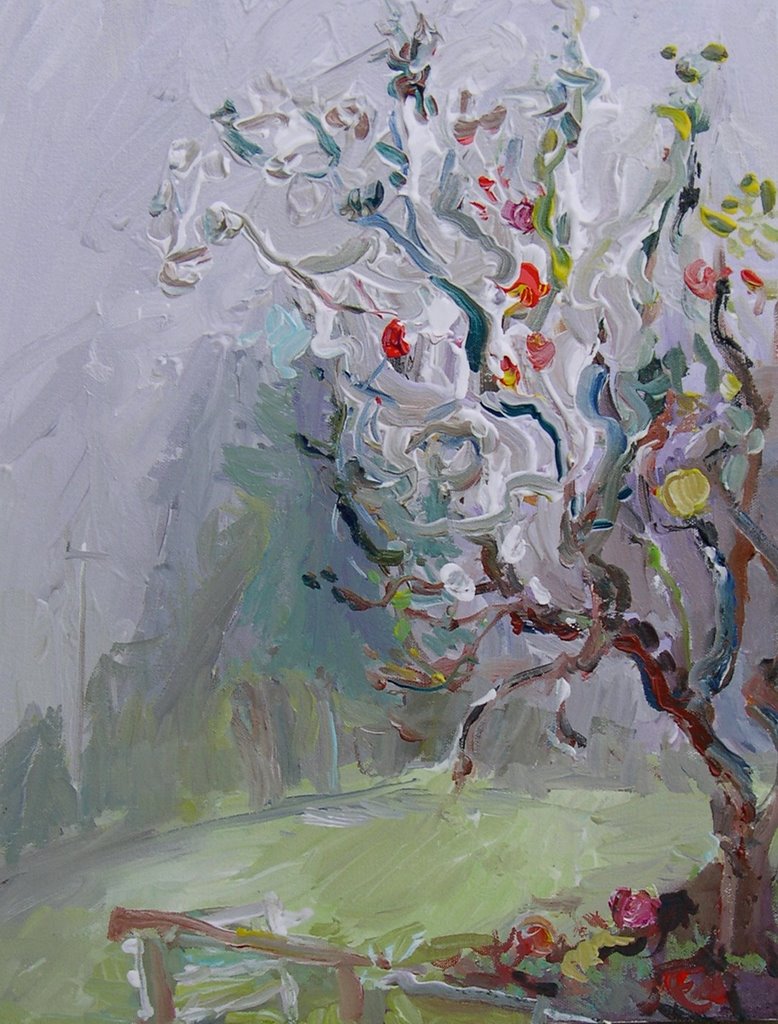
Apple Tree Expressionist Painting:"After Apple Picking"


"After Apple Picking" is inspired by Robert Frost's poem by the same name. The painting is acrylic on stretched canvas, larger than the 5"x 7" that I will be posting. This one is 18" x 14" and $350.


My long two pointed ladder's sticking through a tree
Toward heaven still,
And there's a barrel that I didn't fill
Beside it, and there may be two or three
Apples I didn't pick upon some bough.
But I am done with apple picking now.
Essence of winter sleep is on the night
The scent of apples: I am drowsing off
I cannot rub the strangeness from my sight
I got from looking through a pane of glass
I skimmed this morning from the drinking trough
And held against the world of hoary grass.

Sunday, July 16, 2006

Painting at Ona Beach, Oregon

Both of these paintings have undergone great change. especially the tree. This tree has become the base for painting my own family tree portraits sitting on the branches. This very personal painting was exhibited june 2007 at the Benton County Museum group show, "Seven Years Later"

Outdoors I enjoyed mixing a water and dilute mat medium with pan wtercolors working transparency over transparency. "View Approaching Foot Bridge to Beach", "Tree Standing on the Bank of Beaver Creek" 18" x 18" ( Update: The tree painting became the base for a painting of my family tree and an illustration in the book, "When I Get to be Older")

Wednesday, November 09, 2005

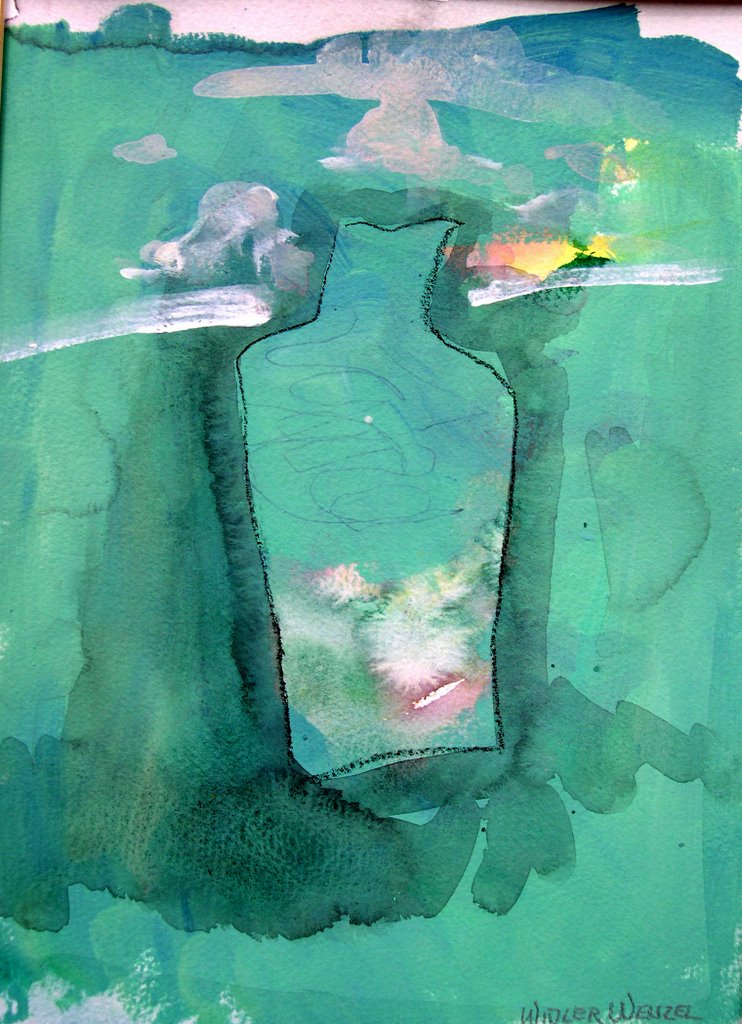
Green Horizon Jar

"Green Horizon Jar" is a quarter sheet watercolor unframed and is for sale. $90

Jars do not pour well; they keep their contents bottled up sometimes calm and sometimes stormy. If there were no waters there would be no storms like we know. I hope all the water melting at the ice caps of our earth is stored in the atmosphere and we will remain a green earth. I hope life here will continue for my grandchildren's children for as long as can be imagined.

UP DATE, September 28, 20009 I am continuing my interest in the meaning of shapes of vessels in my current Children's Ceramic Project.

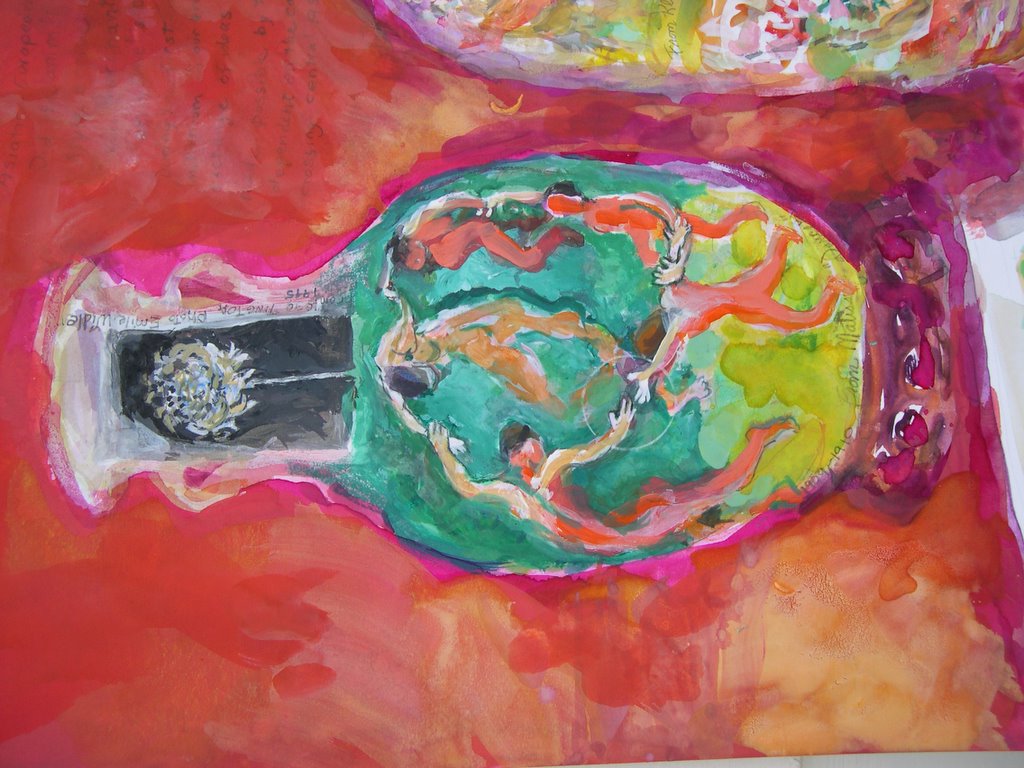
Flower Vessel Overturned with Torn Connections

This is a detail of "Connections" and is sold.

Sunrise, sunset, sunrise the spiral of time turning clockwise like a dancing vessel. War time rips into the fabric of time, the circle dance is either coming together or flying apart as in Matisse's Dancers, 1918. The chrysanthimum photographed by my grandfather in 1930 moves with cosmic time. Is it cut off from the earth? Will it survive? In the cycles of the seasons there will be another Spring and a rebirth.

UPDATE : September 28, 2009. I am continuing my interest in the expression of our humanity in the Children's Ceramic Project.

Tuesday, November 08, 2005

Birth of Flowers in Seed Pod

This half sheet watermedia painting is for sale. $ 100
I saw a dried up daisy sprouting new life in our yard. It got me to thinking. The seed pod was a vessel like a womb. The vase also like a womb is my symbol for creation and the beginnings of all time. Out of the dark comes life again and again.

Vessels

This half sheet watercolor painting is for sale. $100 Our planet earth can be thought of as a vessel holding water and life.
UPDATE: September 28, 2009 All of my past paintings of vessels and vases prepared me for symbolizing what people feel is most precious to them.

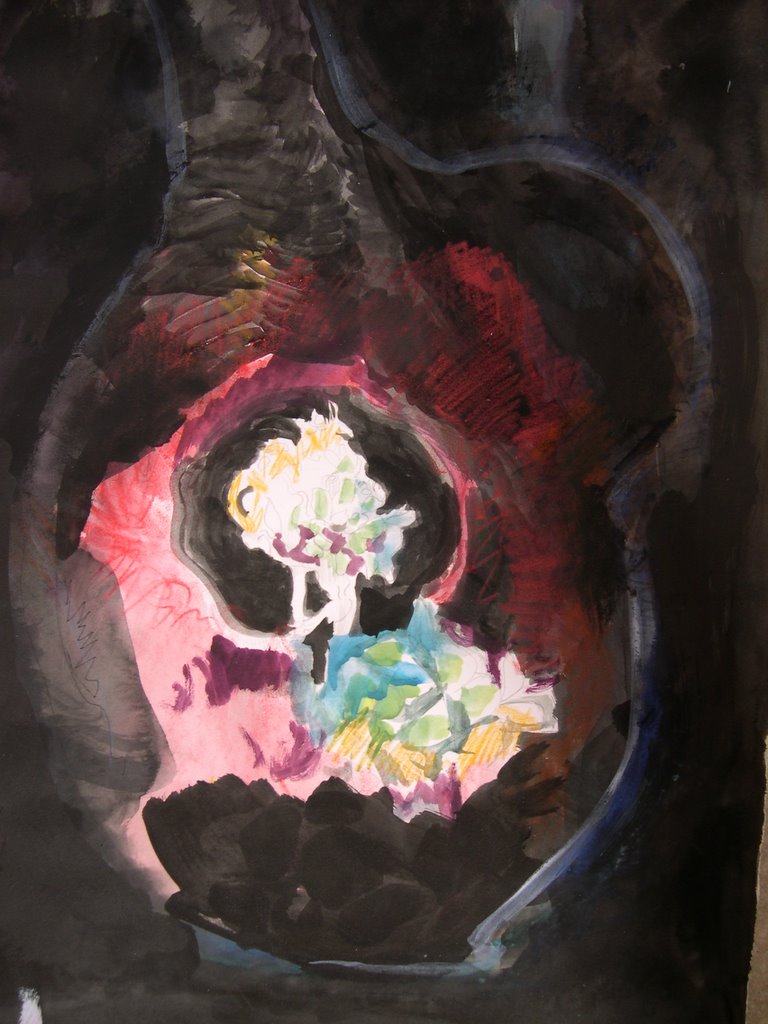
Watercolor Painting Passion

This is on a 30" x 20" watercolor board. For sale. $ 250
UPDATE: September 28, 2009 This is a painting of the hidden insides or basic core of my antique Chinese Mille Fleures Vase made around 1920. I have tried to look down the neck of the vase and can not see the entire interior. It hides something. Something more than physical. I can no longer talk to my grand father who gave it to the family. It has potential that i am exploring in the Children's Ceramic Project.