Hooks found in nature include porcupine quils, cactus thorns, hooked seed pods, sperm to peninsulas that hook water. Man discovering how the hook functions in nature uses the physical properies of the hook form and puts his knowledge to a new use. The new purpose modifies the hook in nature making it an invention.
As an artist what if I used a honeycomb of hexagons to identify geometric pairs in nature? Artists use the grid to enlarge or reduce the scale of photographs as a tool in making representational copies of photographs. Why not study the skies for repeated pairs of hooks forming a mirror image of heart shapes? Pairs of heart shapes curved sides overlapping form a hexagon. The hexagon is inside a pair of equalateral triangles in the shape of a six pointed star. Inside the triangular six points a hexagon with a pair of hearts mirroring the orientation of the hearts on the opposite side. The fractal geometry is not new and has been discovered by artists and mathmeticians. My application of hexagons is an invention of using geometry in making a picture of swirls of clouds so they have a natural look. This application is not original.
Furthermore, in applying this invention I do not draw the honeycomb and fractales. I just use my geometry invention instintctively. The blurry point where discoveries are employed is blurry because artists do not recognize their science in making art.
About Me
- Diane Widler Wenzel
- Documenting a period in my development that could become pivotal
Thursday, June 30, 2011


Wednesday, June 29, 2011

Tuesday, June 28, 2011
A Red Fishing Hook Facing a Reflection

I am planning paintings based on reflections of fishing hooks because I am interested in the emotion of the hook shape and mirror as well as their symbolism.
Monday, June 27, 2011
Hooks in many media
A porcelain hook on a bathroom door intended for towels or bathrobes or such is not my ideal of beauty.


Don with two of our grandchildren at Lava Bute, Eastern Oregon points at the caldera.
There are many hooks that are not attractive. Hooks are on burrs and I pull them out of my socks. I like hooks too. Yelled warnings hook our attention. We then avoid danger. Multiple hooks rip loudly when pulled from the fuzz of Velcro. A hook on ear hangers keep my glasses in place. A hook on my buckel keeps my belt in place. A porcelain hook must be made chunky or it will break easily.
I am surprised that the symbol for the heart and love is made of two hook shapes and I have been cutting out hooks to make hearts.
Sunday, June 26, 2011
Hooks, Hearts and Hexigons
Two hooks joined at the point of action at the lever end of the hook facing each other seeing one another in a mirror for a strong bond of the heart. Two hooks that are back to back let their relationship space out. They break easily.
 Two hearts back to back make a hexigon dream cloud.

Two hooked hearts overlapping.

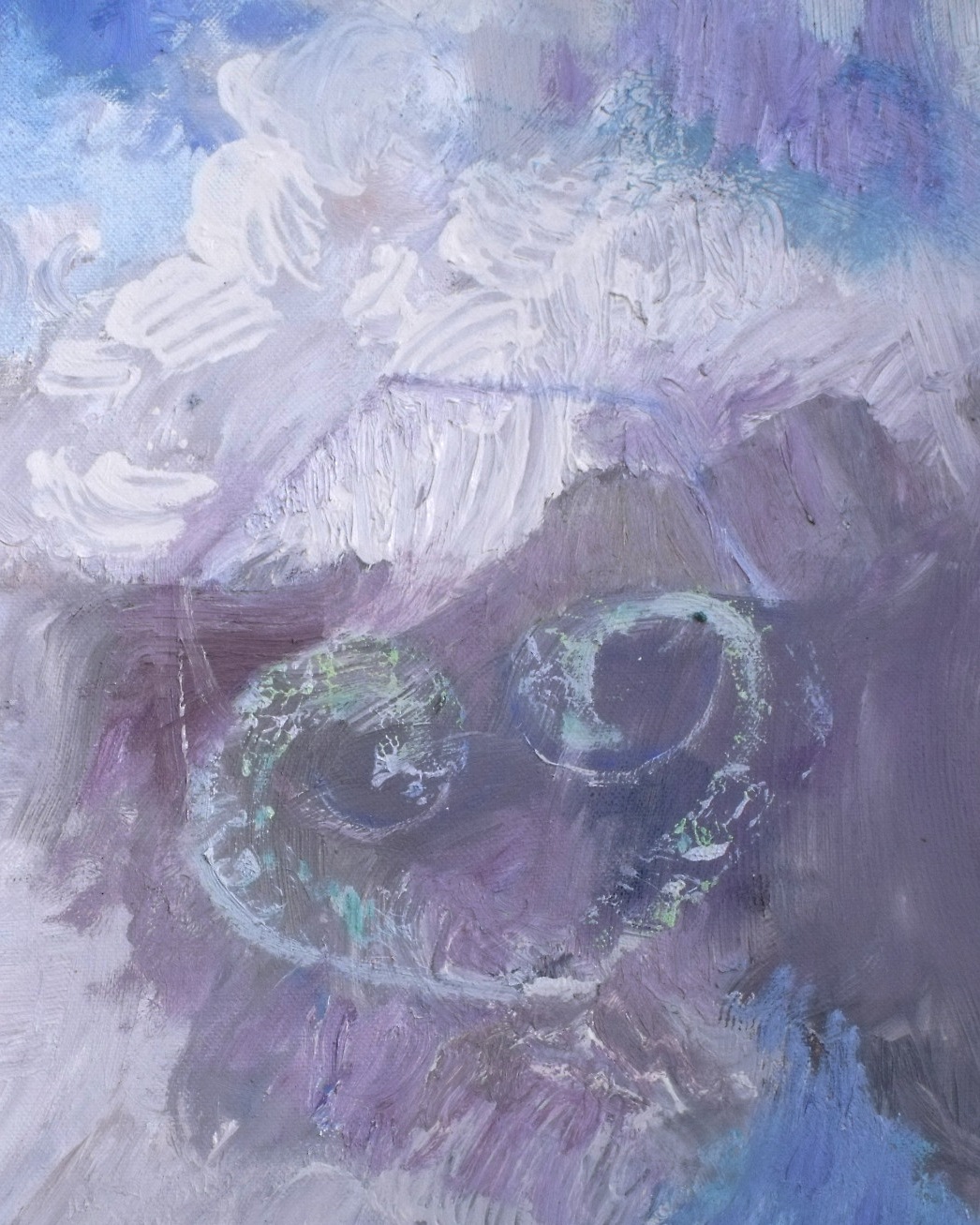 Two hearts back to back make a hexigon dream cloud.
Two hooked hearts overlapping.
Friday, June 24, 2011

Monday, June 20, 2011
Art Activity in Riparian Workshop for science teachers grades 5 -8.

Today I assisted Joseph O'Neil at the Oregon Hatchery Research Center. Joseph O'Neil explained that the object of the entire workshop activities was to help students learn the skill of being scientifically inquisitive and solve problems by thinking outside of the box. The activities were designed for scientific enquiry outdoors. The art project, however, was inside and asked students to close their eyes and imagine being in a healthy riparian meadow with a stream live with flora and fauna.
Usually I work by painting something in general and then the colors and random shapes suggest an imaginary scene. But I thought I knew how to help students put the mind's eye image on paper. I asked them to count the elements in their riparian image and keep the total 5 or under. Pick the one that is most important to them first and decide if it should go on a landscape orientation or a portrait. Then decide if the paper needs to be wider or more narrow and crop as desired. Figure out where to place your most important image and maybe draw the cookie cutter outline of it. Keep it big so there is room for you to comfortably paint the general color upon which you will come back later with detail after it dries. When you have your favorite image planned, the others can be placed.
Some students had five images completed with white space around them. The white was a little stark. So after the paint dries they put very faint color in with a paper towel leaving some white of the paper. Some had nice atmospheric effects in the background but some hard edges where the back of the river met the misty grass. The edges were softened with a cleaned wet brush.
Even without my saying they needed to think about concepts that they had been learning in other exercises. Some did illustrate them in spite of my help. For example, trees bending over the river creating shade for fish spawns. Or the grass being greener closer to the river.
There was discussion on how the experience of painting an imaginary riparian zone could be utilized in their classrooms. Several made suggestions on how the experience could be more vital outdoors. There are watercolor infused papers and watercolor pencils that could be used with much less problems.
In retrospect, I think the paintings could be started outdoors. All the students need is one rock and one paper for each student; two containers to be shared, one with clean water and one with a dilute watercolor. Students could pour clean water on their paper. Then drop the dilute color into the water and watch it spread. Then leave it on slightly sloped ground with a rock weighting it down so it won't blow away. The rock will leave an image of a rock with water swirling around it. After several hours the painting should be dry enough to take inside. The faint image on the paper helps break the terrible feeling of facing a blank page. The image stimulates imagination. Further help could come from listening to Beethoven's Symphony Pastoral. The instructor could read poetry. Real poetry and maybe only parts of what the syllabus suggested.
I would say the text book reading was written by a scientist and would be better if by a poet. Someone suggested music and recorded sounds from a creek. I suggested bringing history into the assignment. That riparian environments have good clays. On river banks the potter's wheel was invented and then the idea of the invention was carried to far away continents by ship. Also the Scythian bronzes were made with bi-lateral symmetry of dragons around the 8th century B.C.. These dragons look like logs reflected in a river at low tide. Early inventions were made when man had leisure time. Inventive investigation and making art were one and the same activity.Inventions can be used in so many different ways that an artist perspective is necessary to insure the use of inventions really does improve the quality of life.
Joseph O'Neil says there is science in everything we do including art. And that in research there is a need for art skills that young researchers do not have. He says many of his research students come to him deficient in building and welding skills.
Usually I work by painting something in general and then the colors and random shapes suggest an imaginary scene. But I thought I knew how to help students put the mind's eye image on paper. I asked them to count the elements in their riparian image and keep the total 5 or under. Pick the one that is most important to them first and decide if it should go on a landscape orientation or a portrait. Then decide if the paper needs to be wider or more narrow and crop as desired. Figure out where to place your most important image and maybe draw the cookie cutter outline of it. Keep it big so there is room for you to comfortably paint the general color upon which you will come back later with detail after it dries. When you have your favorite image planned, the others can be placed.
Some students had five images completed with white space around them. The white was a little stark. So after the paint dries they put very faint color in with a paper towel leaving some white of the paper. Some had nice atmospheric effects in the background but some hard edges where the back of the river met the misty grass. The edges were softened with a cleaned wet brush.
Even without my saying they needed to think about concepts that they had been learning in other exercises. Some did illustrate them in spite of my help. For example, trees bending over the river creating shade for fish spawns. Or the grass being greener closer to the river.
There was discussion on how the experience of painting an imaginary riparian zone could be utilized in their classrooms. Several made suggestions on how the experience could be more vital outdoors. There are watercolor infused papers and watercolor pencils that could be used with much less problems.
In retrospect, I think the paintings could be started outdoors. All the students need is one rock and one paper for each student; two containers to be shared, one with clean water and one with a dilute watercolor. Students could pour clean water on their paper. Then drop the dilute color into the water and watch it spread. Then leave it on slightly sloped ground with a rock weighting it down so it won't blow away. The rock will leave an image of a rock with water swirling around it. After several hours the painting should be dry enough to take inside. The faint image on the paper helps break the terrible feeling of facing a blank page. The image stimulates imagination. Further help could come from listening to Beethoven's Symphony Pastoral. The instructor could read poetry. Real poetry and maybe only parts of what the syllabus suggested.
I would say the text book reading was written by a scientist and would be better if by a poet. Someone suggested music and recorded sounds from a creek. I suggested bringing history into the assignment. That riparian environments have good clays. On river banks the potter's wheel was invented and then the idea of the invention was carried to far away continents by ship. Also the Scythian bronzes were made with bi-lateral symmetry of dragons around the 8th century B.C.. These dragons look like logs reflected in a river at low tide. Early inventions were made when man had leisure time. Inventive investigation and making art were one and the same activity.Inventions can be used in so many different ways that an artist perspective is necessary to insure the use of inventions really does improve the quality of life.
Joseph O'Neil says there is science in everything we do including art. And that in research there is a need for art skills that young researchers do not have. He says many of his research students come to him deficient in building and welding skills.
Friday, June 17, 2011
Illustrations From Aleph to Ze'ev by Ze'ev Orzech


(Ze'ev and I signed his book for Beit Am members and friends.)
Last night was the celebration of a book by Ze'ev Orzech, From Aleph to Ze'ev, Excursions into Jewish Culture, History, Rituals and Beliefs contains a 110 articles about topics of interest that have appeared in the Beit Am's monthly newsletter over the past 20 years. My small supportive role in making of the book consists of a few illustrations that appear mostly on the cover. I was surprised that my work was adapted to the cover. Under the contract I drew up I gifted the digital images of the illustrations to Beit Am and gave my permission to Ellen Perlis to make any changes she saw fit to give the strongest support to her vision of the book. I am more than pleased with the results.
Beit Am Publications is making the book available for sale for, $19.95. It is at the Grass Roots Book Store in Corvallis and on line at http://www.beitam.org/publications
Friday, June 10, 2011
Lisa See's book signing at Powells in Beaverton, Oregon

To meet Lisa See, the author of the number one best seller, DREAMS OF JOY, I missed an art opening of a group show with three of my paintings at LaSelles Stewart Center's Guistina Gallery, in Corvallis. I certainly had a treat as the crowd gathered, I was not surprised that there was standing room only. Finally the gate was opened into the mall promenade.
Lisa talked about her life and writing process which is similar to a fine arts painter. She first thinks about the emotion in relationships. In SHANGHAI GIRLS she wrote about sisters escaping Japanese occupied Shanghai. In JOY'S DREAM a worried mother searched for her daughter in Mao's Communist State. A painter also looks for an emotional hook to draw the viewer into their paintings.
Lisa keeps a notebook of Chinese anachronisms. For example, a mother sets a direction for their child in adulthood and they will do what they want. This becomes the movement in her book. She does research about every aspect of Chinese history. Painters do drawings expressing the energy of an overall impression that they want to achieve in their finished work.
Lisa does extensive research everywhere. She goes and lives where her characters live. She even eats their food. Likewise the painter is immersed in their subjects.
One of the most important comparison between Lisa's writing and that of a painter is discipline. She writes I think it is a 1,000 words a day. Sometimes she writes it in 2 hours . Some days takes 10 hours. Discipline and balance between work and family is what women writers and painters have in common.
I highly recommend all of Lisa See's books including SNOW FLOWER AND THE SECRET FAN and PEONY IN LOVE.
Monday, May 09, 2011


Sunday, May 08, 2011
Plein Air Two Hand View Finder or Painting Mask
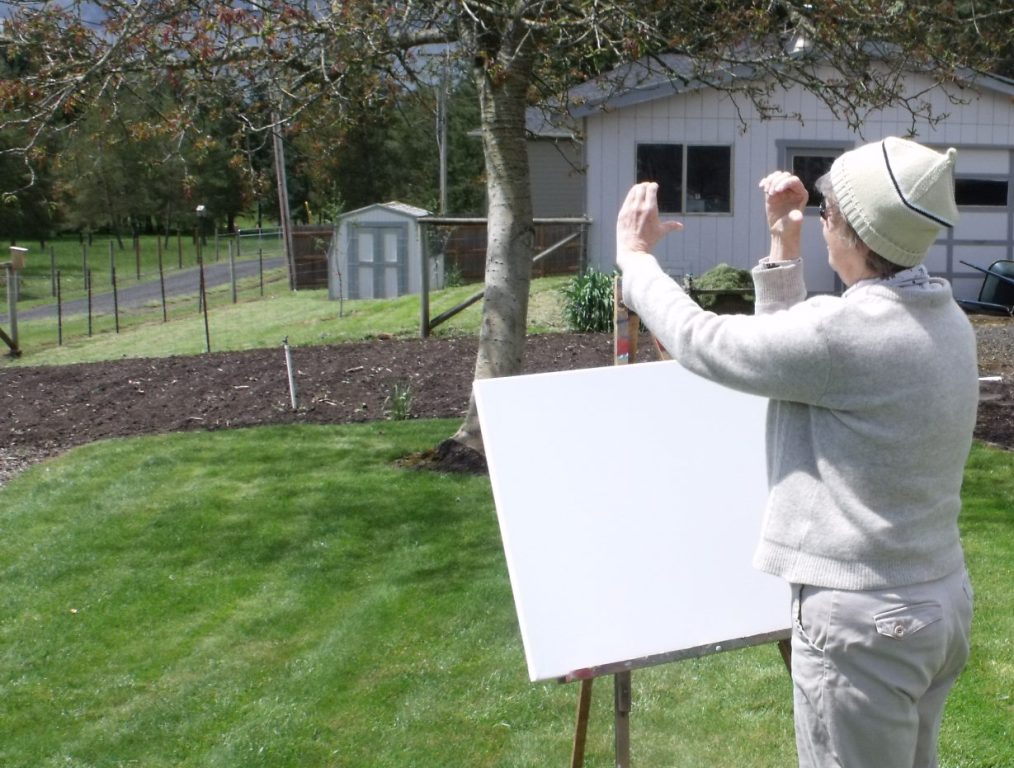
My right arm is bent at the elbow at 90 degrees and held firmly while the left moves. The closer the arm is to a straight line the smaller the image is in the box formed by my fingers just like a camera viewfinder. In addition a 21 box grid can be made by spreading the fingers apart and flicking the left wrist to lineup with the left arm. 
At the Lima Anthropology Museum there is a diorama display of what anthropologists think Mesoamericans' camps were like around 14,ooo B.C. Most of the activities were self explainable except one man wearing an animal's head disguise. He was facing the wind break enclosure. He appears to be sizing up a distant object. He could be measuring where to put another support pole to add to the enclosure or judging from his posture. He could be roughly gaging the speed of movements of people or animals on the horizon.
Friday, April 29, 2011
Painted over one "Bond Butte Quarry Fishing"
This is a gift to Corvallis Fish and Wildlife office for the fine job they do organizing volunteers to donate trees for fish habitat at Bond Butt gravel pond on Interstate Highway 5. This is an acrylic painting 12 inch square.

Sunday, April 24, 2011
My shoe box card/books
Here are a few of the card /books that my grandfather sent us.
 When I was a young child I was impressed by my grandfather's shoe box that he filled with his small watercolor paintings on paper folded as greeting cards. He painted a band on the left side to symbolize the gold or silver gilt on precious bound books. He had a printer make inserts with the greeting.
For about 15 years I have been making accordion watercolor books and storing them in shoe boxes. Sometimes they become greeting cards that I make for family and friends.
Below are a series I made on a cruise to South America. Most of these small painted books are painted outdoors. Below is one I did this week when a grandmother came with three of her grandchildren.
We painted out on our patio.
Tuesday, April 05, 2011


Sunday, March 27, 2011
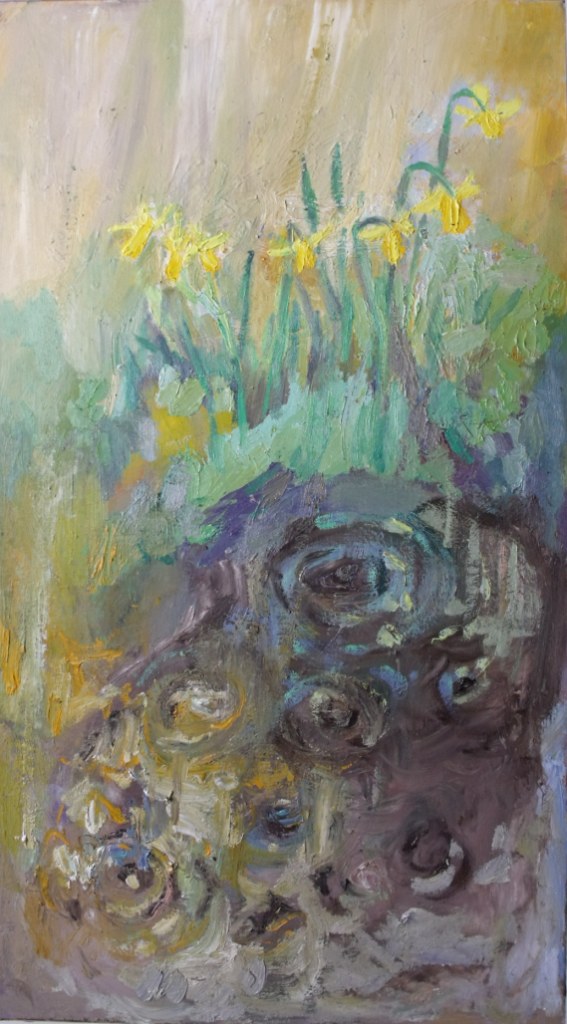
Daffodils in the Rain
For a month now I have been doing black and white drawings of the ripples made by rain drops on a tiny pool of water that rises up by our miniature daffodils. None of the sketches really helped in the way I paint wet into wet oil.

Friday, March 25, 2011
the grid is an imperfect drawing tool
I am making a Power Point slide show about inventions for my grandchildren who are now teen- agers. One of the most important historic inventions is the grid according to my grandfather Emile Widler. He used to draw a grid over his photographs and then enlarge them for watercolors. Searching the Internet for a match for one of his paintings of Chinese Emperors, I found a photo that matched his painting especially in the eyes ears and general shape of the face. Then I drew a grid over a copy of the photo and made an enlargement. I was amazed at how closely the lines matched my grandfather's except for purposeful changes like removing the mustache and making baby doll lips.
 I usually do not like copying photos because there is no need to understand the volumes and the lighting. It is a mathematical exercise. However, in the case of my grandfather's portraits, he deviated enough to communicate his feelings on this emperor with tiny lips and a high forehead. It is alittle humorous.
 I usually do not like copying photos because there is no need to understand the volumes and the lighting. It is a mathematical exercise. However, in the case of my grandfather's portraits, he deviated enough to communicate his feelings on this emperor with tiny lips and a high forehead. It is alittle humorous.
Sunday, March 20, 2011
Drawing Preparations for Painting
Traditionally drawing is the recommended foundation for painting. Yet, I always yearn to have paintings that are direct and fresh and alive. If I do a drawing first the painting is likely to loose life and spontaneity. I am so anxious to have the thrilling experience of getting a painting that comes together without being overworked, I neglect drawing.
Day before yesterday I painted daffodils outside in the cold. My first oil painting of the season. It didn't work.
Day before yesterday I painted daffodils outside in the cold. My first oil painting of the season. It didn't work.
Thursday, March 17, 2011
Drawing Kissed by the Sun's Promise of Spring

At mid-afernoon the clouds were spreading and dissapearing. I could feel a faint warmth on my cheek as I marveled at the angle of the sun kissing them as they kept dispersing.
Drawing Faint and Ephemeral Clouds

March 2nd marked the beginning to an at home journey to viewing the spectacular without leaving my doorstep. I have my eyes on the sky all day and into the twilight hours. I make quick pen and ink drawings just a few inches on a side. Usually nine to a page.
There are some difficulties on my journey in the skies overhead. Some mornings on first glance I see a flat gray sky. But looking a few minutes at the undefined fluff, I am surprised to see subtle changes between the horizon and zenith. I record them in greater contrast.I also see differences between clouds looking at them from different windows on different sides of the house.
This month the clouds move into new formations before I can fully plot the volumes of clouds and their relationships to one another. That is OK, I just strive to get as much as I can down. Often I follow a line in the sky with my eye as a I draw without looking at the paper until I have an area plotted and I go back to shade always in greater contrast.
As I draw I look at the dark lines and judge that my drawing is too defined to be clouds. The spidery lines look unreal when judgement creeps in on me prematurely. I ignore my shock. I continue being too bold because I know I am in a foreign area to my previous work. I am stretching new compositions and expressiveness.
I have a new plan to draw the ephemeral. I have always been sad that wet into wet paintings look so wonderful before they dry. Now I will begin drawing ink sketches of drying paint at its most dramatic. The drying is slower moving than clouds in March.
There are some difficulties on my journey in the skies overhead. Some mornings on first glance I see a flat gray sky. But looking a few minutes at the undefined fluff, I am surprised to see subtle changes between the horizon and zenith. I record them in greater contrast.I also see differences between clouds looking at them from different windows on different sides of the house.
This month the clouds move into new formations before I can fully plot the volumes of clouds and their relationships to one another. That is OK, I just strive to get as much as I can down. Often I follow a line in the sky with my eye as a I draw without looking at the paper until I have an area plotted and I go back to shade always in greater contrast.
As I draw I look at the dark lines and judge that my drawing is too defined to be clouds. The spidery lines look unreal when judgement creeps in on me prematurely. I ignore my shock. I continue being too bold because I know I am in a foreign area to my previous work. I am stretching new compositions and expressiveness.
I have a new plan to draw the ephemeral. I have always been sad that wet into wet paintings look so wonderful before they dry. Now I will begin drawing ink sketches of drying paint at its most dramatic. The drying is slower moving than clouds in March.
Sunday, March 06, 2011
Drawings Versus Sketches, and Cartoons,
My drawing efforts are tacked up on a board where I can look at them every day.

" draw-ing n. 2: the art or technique of representing an object or outlining a figure, plan, or sketch by means of lines" 3: Something drawn... b) a representation formed by a drawing
"sketch n. 1: a) a rough drawing representing the chief features of an object or scene and often made as a preliminary study"
"cartoon n. 1: a preparatory design, drawing or painting ( as for a fresco) 2: a) a satirical drawing commenting on public or usu. political matters b) comic strip
All three, drawings, sketches and cartoons require the act of drawing to produce them. As an artist in the process of making art, I hope when I am drawing that I accomplish my aim of making something I can be proud to say is a drawing. When I fall short of my intentions I call it not a failure but a sketch in preparation for a drawing I can call art.
This month I am drawing every day. At the beginning of the month I said I would do a drawing a-day but that goal may be highly optimistic.
Subscribe to:
Posts (Atom)